Application selector

Nichia lighting criteria by installed environment

Start with the visual task and mounting condition, then compare distribution, color, electrical, controls, and maintenance constraints.

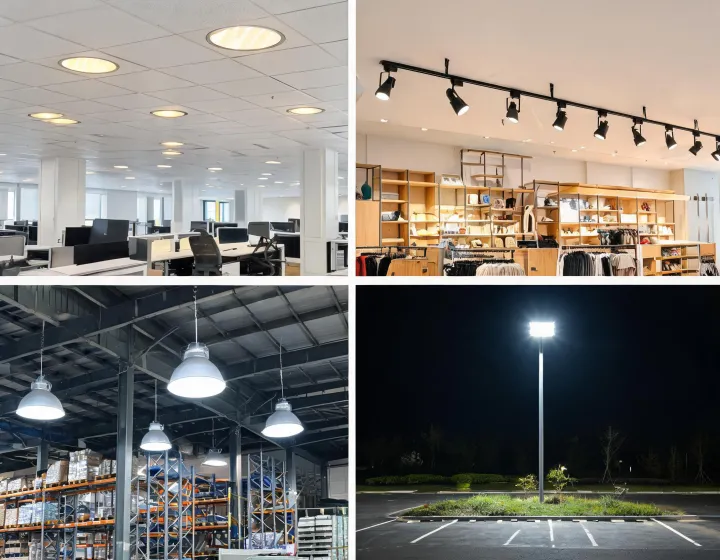
Commercial lighting application montage

Office, education and healthcare

Use task illuminance and visual-comfort criteria to set luminous flux and distribution. Review UGR through complete-luminaire photometry, while CCT, CRI and TM-30 support the intended visual environment. Occupancy sensing and daylight harvesting add response-time, standby and commissioning requirements. Maximum lm/W lowers input power, but may conflict with glare control or color quality; project priorities determine the balance.

Retail and hospitality

Accent beams, vertical illumination, scene changes and camera use make color consistency and low-end dimming visible. Compare beam angle, candela distribution, CCT and CRI alongside the drive current and thermal path. Integrated sources allow compact forms; serviceable assemblies can reduce disruption later. Neither route is universally preferable because housing size, maintenance access and replacement policy differ.

Industrial and warehouse

High operating hours, elevated ambient temperature, dust and difficult access require a defined L70 basis, thermal condition, ingress arrangement and surge plan. IP65 describes a tested enclosure condition, not every cable entry or installed assembly. Measurements taken on an open bench must be repeated in the intended high-bay housing after thermal stabilization.

Outdoor infrastructure

Roadway, area, facade and sports projects coordinate luminous flux, BUG rating, aiming, nighttime controls, surge protection and weather exposure. Centralized controls simplify policy management; distributed nodes support zoning and local fault isolation. The architecture changes wiring, commissioning and maintenance, so protocol selection cannot be reduced to a connector label.

Selection checklist

1. Define the task

Record target illuminance, uniformity, glare limit, CCT, CRI, operating hours, and any spectral or camera requirements.

2. Define the assembly

Name the source, optic, drive condition, mounting, enclosure, ambient range, controls, and intended service method.

3. Define acceptance

Identify LM-79 or other applicable measurement evidence, project calculations, sample tests, commissioning checks, and the responsible reviewer.

Typical examples such as 12,000 lm, 150 lm/W, 3000 K or 4000 K, Ra 90+, IP65, and L70 50,000 h are comparison formats—not claims for every product. Confirm exact values, conditions, and certification scope in the current product documentation.

Turn application constraints into a short selection brief

Share the space, mounting, optical targets, environment, controls narrative, and acceptance path.